A Homeowner’s Guide to Plywood, Melamine, MDF, and Particleboard Materials For Kitchen Cabinets
Choosing the right cabinet material is one of the most important decisions when planning a new home, renovation, or custom cabinetry project.
Most homeowners naturally focus on what they can see first: the cabinet colour, woodgrain texture, countertop, handles, and overall interior style. But the material inside the cabinet matters just as much as the finish outside.
A cabinet may look beautiful on the first day, but the real test begins after years of daily use. Kitchen cabinets are opened and closed every day. Wardrobes carry heavy clothes. Storage cabinets hold appliances, cookware, pantry items, books, bags, and household essentials.
In Malaysian homes, cabinetry also needs to handle humidity, cooking steam, air-conditioning changes, and occasional water exposure.
This is why plywood is often recommended for long-term built-in cabinetry. Compared with many standard particleboard options, plywood offers better strength, better stability, and better durability for everyday use.
Key Takeaways
- Plywood is a strong material choice for kitchen cabinets, wardrobes, TV cabinets, shoe cabinets, and built-in storage.
- Melamine is popular because it is affordable, clean-looking, and easy to maintain.
- Melamine is usually a surface finish applied over particleboard or MDF, so the core material still matters.
- Particleboard and MDF can be more budget-friendly, but they may be more sensitive to moisture, swelling, and sagging.
- Plywood is made from layers of wood veneer, which gives it better strength and long-term stability.
- For Malaysian homes, plywood is often a better long-term choice for areas exposed to humidity, weight, and daily use.
How We Compare Cabinet Materials
To make this guide practical, we compare common cabinet materials from a homeowner’s point of view.
The comparison focuses on three key areas:
- Daily durability
How well the material handles everyday household use. - Moisture resistance
How the material reacts to humidity, spills, and damp conditions. - Long-term value
Whether the material remains reliable after years of use.
This article also refers to publicly accessible sources, including the U.S. Environmental Protection Agency’s formaldehyde standards for composite wood products, wood material references, and cabinet material guidance, to support key claims about composite boards, plywood, particleboard, and formaldehyde emissions. The EPA notes that composite wood products covered under its formaldehyde standards include hardwood plywood, medium-density fibreboard, and particleboard, as well as finished goods containing these materials.
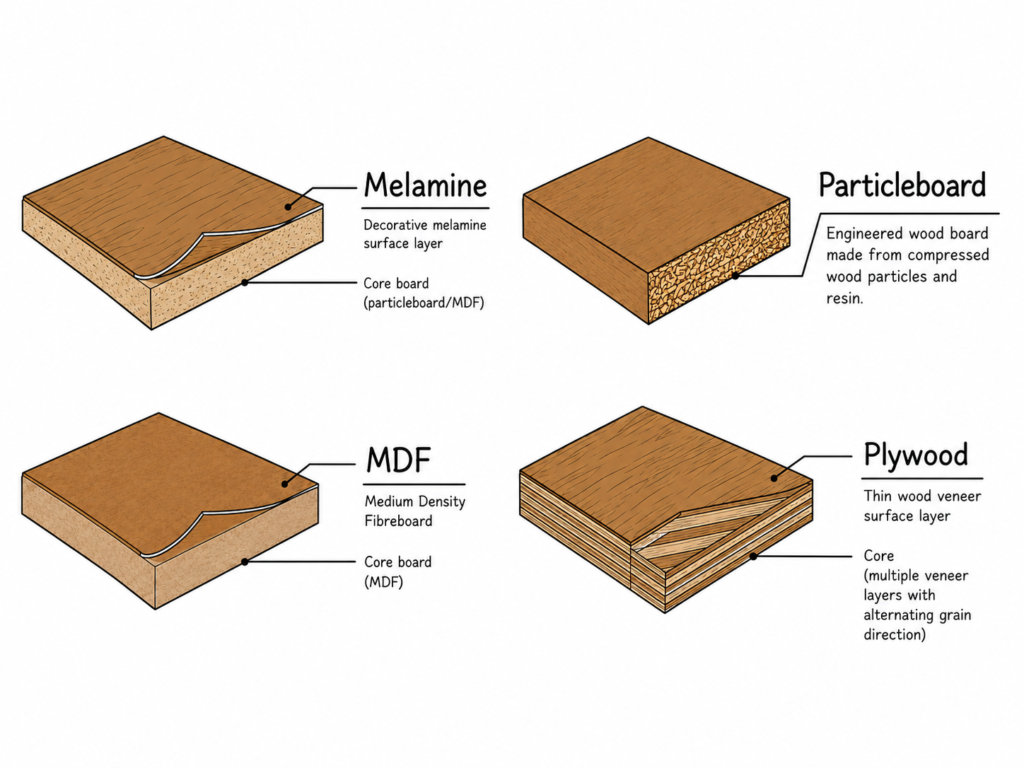
What Are the Common Cabinet Materials Homeowners Choose?
1. Melamine Cabinets
Melamine is one of the most common choices for modern cabinetry because it is affordable, easy to clean, and available in many colours and woodgrain finishes.
However, melamine is usually only the surface layer. It is commonly applied over particleboard or MDF.
This means the durability of a melamine cabinet depends heavily on the core material underneath. A melamine cabinet may look clean and modern on the outside, but if the inner board is weak, it may still face problems over time.
2. Particleboard Cabinets
Particleboard is made from wood chips or wood particles bonded together with resin. It is widely used because it is budget-friendly.
However, particleboard is generally weaker than plywood. It can also swell when moisture enters the board through exposed edges, damaged corners, or poorly sealed areas.
For dry and low-impact areas, particleboard may still be suitable. But for kitchen cabinets, bathroom vanities, laundry areas, and humid spaces, homeowners should understand its limitations.
3. MDF Cabinets
MDF, or medium-density fibreboard, is made from fine wood fibres pressed together with resin.
It has a smooth surface, making it suitable for painted finishes, decorative cabinet doors, and certain design details.
However, MDF is not always ideal for cabinet carcasses that need to carry heavy weight or handle moisture. When exposed to water, MDF can swell or lose strength.
4. Plywood Cabinets
Plywood is made by bonding thin layers of wood veneer together. These layers are usually arranged in alternating grain directions.
This layered structure gives plywood better strength, better stability, better screw-holding ability, and better long-term durability.
That is why plywood is often recommended for kitchen cabinets, wardrobes, TV cabinets, shoe cabinets, bathroom vanities, and full-height built-in storage.
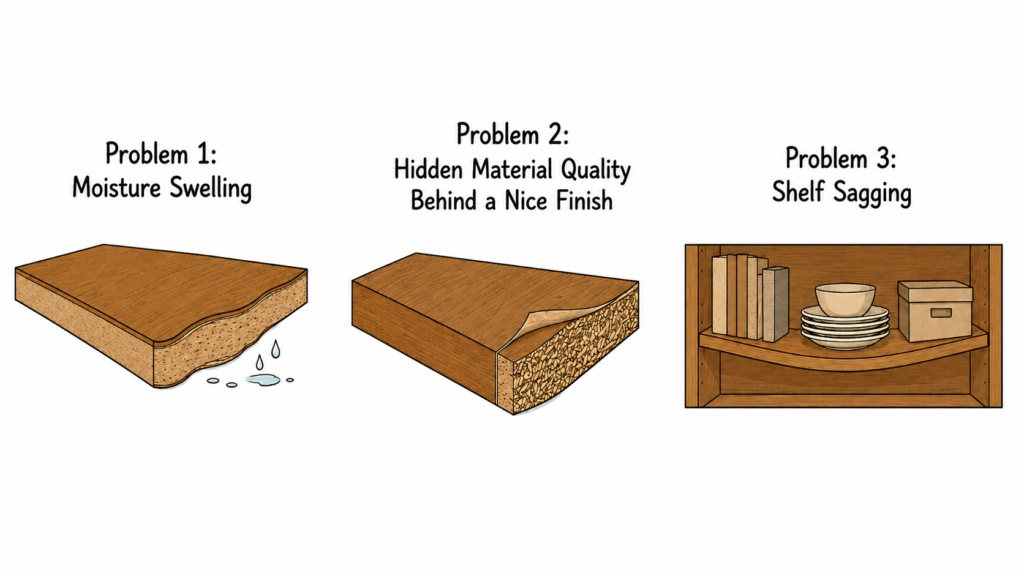
Plywood vs Melamine, MDF, and Particleboard: Common Problems to Know in Kitchen & Other Cabinets
Problem 1: Moisture Swelling
Moisture swelling is one of the most common problems with lower-grade cabinet boards. This usually happens when water or moisture enters the board through an exposed edge, damaged corner, screw hole, sink cabinet, or poorly sealed joint.
Once particleboard absorbs moisture, it can expand and lose its original shape. In many cases, the swelling is difficult to reverse.
For homeowners, moisture damage may appear as:
- Puffy cabinet edges
- Uneven door alignment
- Warped panels
- Peeling surface layers
- Cabinet bases that look bloated near wet areas
This is especially relevant in Malaysia, where kitchens and wardrobes often deal with a mix of humidity, air-conditioning, cooking steam, and occasional water exposure.
Problem 2: Hidden Material Quality Behind a Nice Finish
A clean melamine finish can make different cabinet boards look similar at first glance.
This is why homeowners should not judge cabinet quality by surface appearance alone.
The outer finish matters, but the inner core determines long-term performance. A cabinet can look smooth, modern, and premium on the outside. But if the core board is not suitable for daily use, moisture, or weight, problems may appear after installation.
Problem 3: Shelf Sagging
Cabinets are not just decorative. They carry weight every day.
In kitchens, shelves may hold plates, bowls, dry food, cookware, and small appliances. In wardrobes, they may hold folded clothes, bags, luggage, or storage boxes. Over time, weaker boards may start to bend or sag, especially across wider spans.
This is where material stiffness matters. Cabinet construction references note that strength and stiffness are important because cabinets need to retain their shape and support heavy loads over time.
What Is Plywood?
Plywood is a manufactured wood panel made from thin layers of wood veneer.
These layers are glued together under pressure, usually with the grain direction alternating between each layer. This cross-layered structure is what gives plywood its strength. In simple terms, each layer supports the next. Because the wood grain runs in different directions, the board becomes more balanced and stable.
This helps plywood resist splitting, warping, and movement better than many lower-grade board materials. Instead of relying on compressed wood particles, plywood uses larger sheets of wood veneer. This makes it especially useful for cabinetry areas that need to carry weight, hold hardware, and stay stable over time.
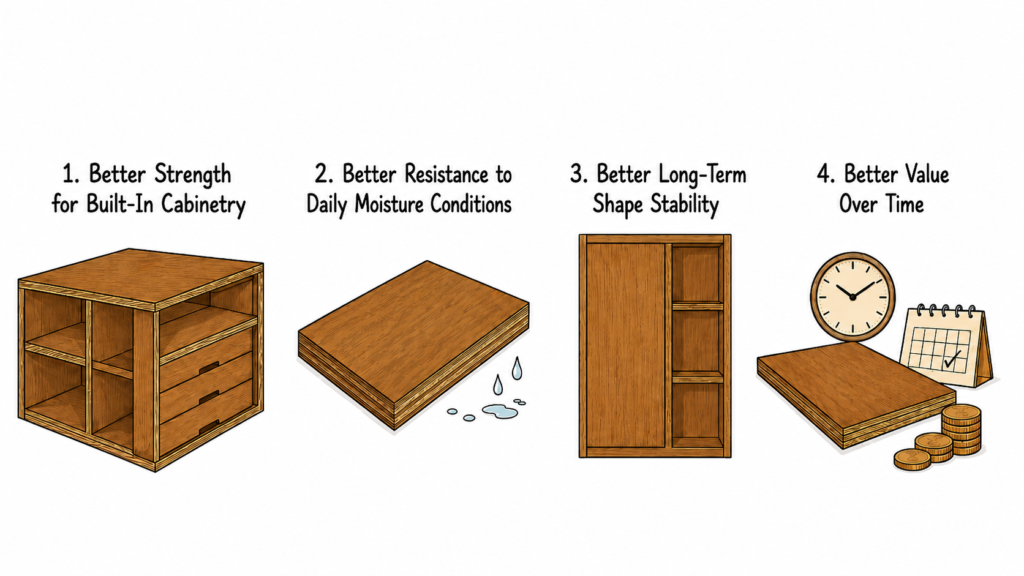
Why Plywood Is a Better Choice For Kitchen & Other Cabinets
1. Better Strength for Built-In Cabinetry
Built-in cabinetry is a long-term part of your home.
Unlike loose furniture, it is measured, fabricated, installed, and fixed into the space. That means the material needs to perform for years, not just look good during handover.
Plywood provides better structural strength compared with many standard particleboard options. Its layered veneer construction creates a stronger board that can support heavier use in kitchens, wardrobes, TV cabinets, shoe cabinets, and storage areas.
2. Better Resistance to Daily Moisture Conditions
No wood-based board is completely waterproof unless it is specially treated and detailed for that purpose.
However, plywood generally performs better than standard particleboard when exposed to normal household moisture, especially when paired with proper lamination, edge banding, and installation workmanship.
This matters in spaces like:
- Dry kitchens
- Wet kitchens
- Laundry areas
- Bathrooms and vanities
- Sink cabinets
- Wardrobes near external walls
- Shoe cabinets near entrances
Wood naturally interacts with moisture, and changes in moisture can cause swelling, shrinkage, and stiffness changes. The advantage of plywood is that its cross-layered structure helps control movement better than many lower-grade board materials.
3. Better Long-Term Shape Stability
Good cabinetry should remain aligned. Doors should close properly. Gaps should stay consistent. Shelves should remain straight. Tall panels should not warp easily. Plywood’s alternating grain direction helps improve dimensional stability. This means the board is less likely to move excessively in one direction.
This is especially important for:
- Full-height cabinets
- Kitchen tall units
- Wardrobes
- Long storage panels
- TV feature walls
- Kitchen islands
For homeowners, this means the cabinet has a better chance of staying neat and functional over time.
4. Better Value Over Time
Plywood usually costs more than standard melamine particleboard.
But the better question is not only, “Which one is cheaper now?”
The better question is, “Which one will hold up better after years of daily use?”
If a cheaper board starts swelling, sagging, or loosening earlier, the repair or replacement cost may become more frustrating later. For homeowners planning to stay in the house long-term, plywood often makes more sense because it supports durability, hardware stability, and daily practicality.
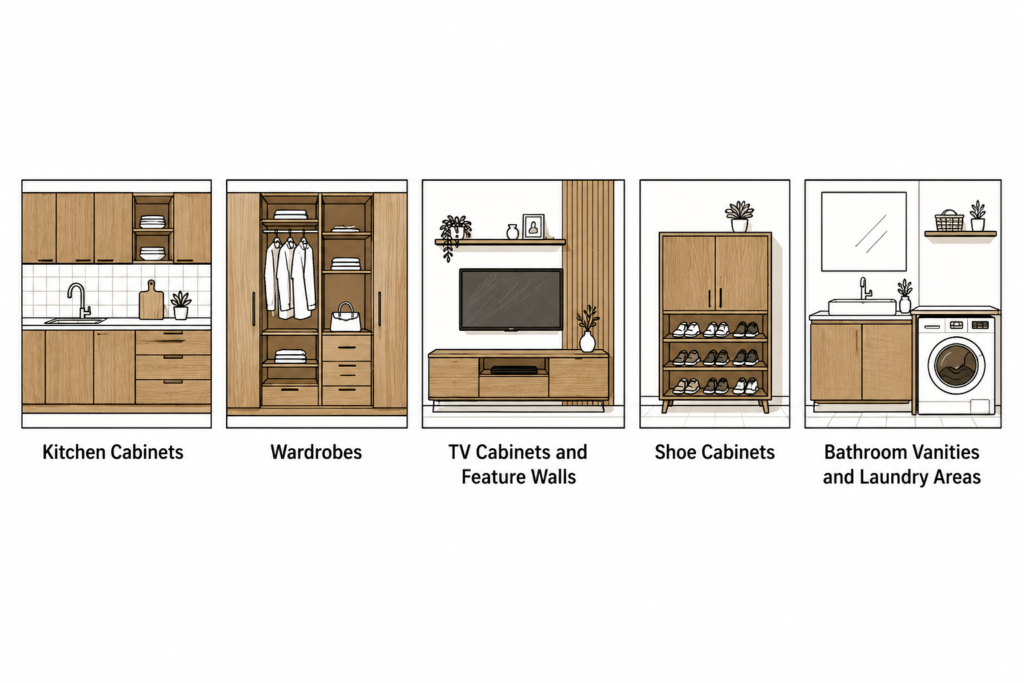
Where Should You Use Plywood in the Home?
Plywood is especially recommended for areas that experience frequent use, heavier loads, or higher moisture risk.
Kitchen Cabinets
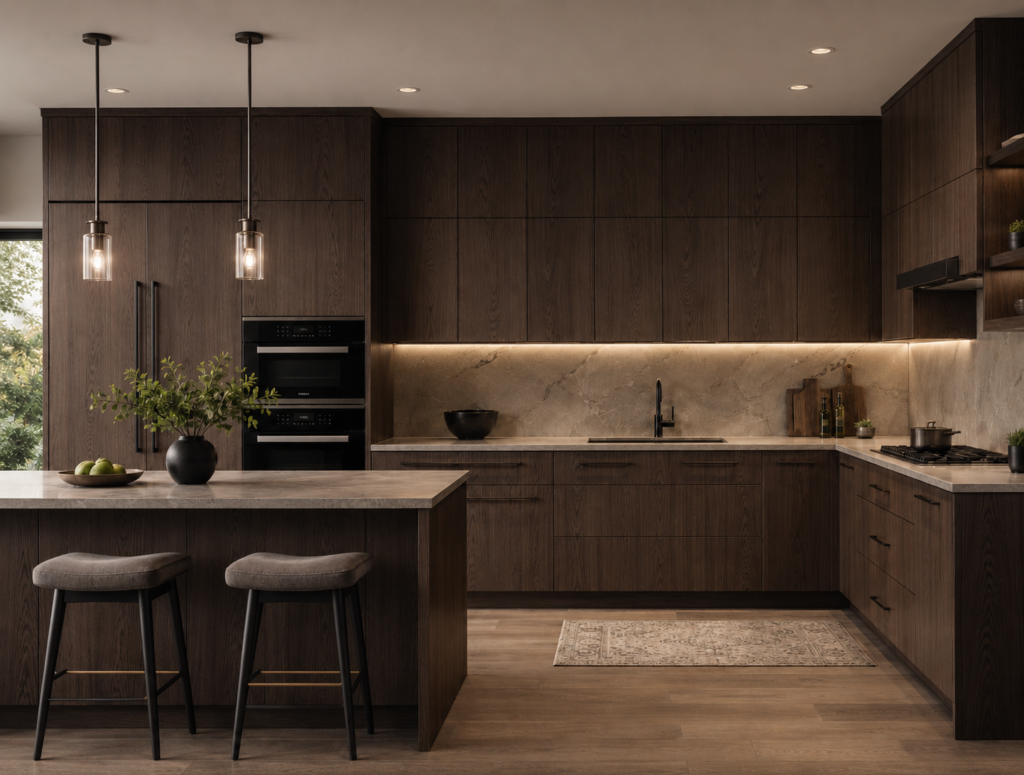
The kitchen is one of the hardest-working areas in the home. Cabinet doors are opened constantly, shelves carry weight, and the space is exposed to heat, steam, spills, and cleaning. Plywood is a strong choice for kitchen carcasses, tall units, sink areas, and island structures.
Wardrobes
Wardrobes need to hold hanging clothes, folded items, drawers, accessories, and sometimes luggage. Full-height wardrobe panels also need good stability to stay aligned. Plywood helps create a stronger wardrobe structure, especially for custom designs that go from floor to ceiling.
TV Cabinets and Feature Walls
TV feature walls often include long panels, display shelves, hidden storage, and sometimes stone or lighting details. A stronger backing material helps the whole structure feel more secure.
Shoe Cabinets
Shoe cabinets deal with daily opening, closing, weight, and sometimes moisture from shoes. Plywood gives better durability for long-term use.
Bathroom Vanities and Laundry Areas
These spaces are more exposed to moisture. While proper waterproofing, ventilation, and sealing are still important, plywood is generally a safer base choice than standard particleboard in these higher-risk areas.
What Homeowners Should Ask Before Choosing Cabinet Materials
Before confirming your cabinetry, ask these questions:
- What is the core material behind the finish?
- Is it plywood, MDF, particleboard, or another board type?
- Where will this material be used?
- Will the area be exposed to moisture or heavy daily use?
- How will the edges be sealed?
- What type of hardware will be installed?
- Is the material suitable for long-term built-in cabinetry?
- Does the board meet low-formaldehyde or relevant indoor safety standards?
This last point matters because many wood-based panels use adhesives or resins, and formaldehyde emissions are regulated in composite wood products such as hardwood plywood, MDF, and particleboard. The EPA’s formaldehyde rule requires regulated composite wood products and finished goods containing them to comply with emission standards and labelling requirements.
Final Thoughts: Is Plywood Worth It for Cabinets?
When choosing cabinetry for your next home, the surface finish is only one part of the story. Melamine can look clean and modern. Particleboard can help reduce cost. MDF can work well for certain decorative or painted applications. But when it comes to long-term built-in cabinetry, plywood offers a stronger and more reliable foundation. It gives better strength, better stability, better screw-holding ability, and better confidence for daily use.
At Nest Butler, we believe cabinetry should not only look good during handover. It should continue to feel solid, practical, and dependable years after installation. If you are planning a kitchen, wardrobe, TV cabinet, shoe cabinet, bathroom vanity, or full-home cabinetry project, plywood is worth serious consideration.
Because the material you choose today will decide how your home performs tomorrow.
To learn more about plywood and whether it suits your home, book an appointment with our project specialist for a personalized consultation.
Frequently Asked Questions About Plywood Cabinets
Is plywood better than melamine?
Plywood and melamine are not exactly the same type of comparison. Plywood is usually the core board, while melamine is often a surface finish applied over a board such as particleboard or MDF. A melamine-faced board can look clean and modern, but plywood usually offers better strength and long-term durability as the base material.
Is plywood waterproof?
Standard plywood is not fully waterproof. However, plywood generally handles normal household moisture better than standard particleboard, especially when it is properly laminated, edge-banded, and installed. For high-moisture areas, the type of plywood, adhesive quality, surface finish, edge sealing, and ventilation all matter.
Why is plywood more expensive?
Plywood costs more because it is made from layers of wood veneer and generally offers better structural performance than many cheaper compressed particle boards. The higher cost usually reflects better strength, screw-holding ability, and long-term stability.
Can plywood still have formaldehyde?
Yes, plywood can still contain adhesives, and some plywood products may emit formaldehyde depending on the glue system and certification. That is why homeowners should ask about the board’s emission rating, such as E0, E1, CARB Phase 2, or TSCA Title VI compliance where applicable.
Is plywood suitable for kitchen cabinets?
Yes. Plywood is one of the stronger choices for kitchen cabinets because kitchens involve frequent use, heavier storage, moisture exposure, and constant hardware movement.
Is plywood suitable for wardrobes?
Yes. Plywood is suitable for wardrobes, especially full-height wardrobes, walk-in wardrobes, and storage systems that need to carry weight and stay aligned over time.
Should I choose plywood for the whole house?
Not necessarily. Plywood is recommended for high-use, high-load, and higher-risk areas. For certain dry or low-impact areas, other materials may still be acceptable depending on budget and expectations. A good cabinetry specialist should advise where plywood matters most.