A Homeowner’s Guide to E0, Super E0 and F4 Stars Low-Formaldehyde Cabinet Materials in Malaysia
Choosing the right cabinet material is not only about colour, durability, water resistance, price, or design style.
For modern homes, there is another important detail homeowners should understand: formaldehyde emission.
Formaldehyde is commonly associated with adhesives and resins used in engineered wood products such as plywood, particleboard, MDF, and other composite wood panels. Since built-in cabinetry can cover large areas inside the home, the material selected for your cabinets may affect indoor air quality, especially in enclosed spaces with limited ventilation.
This is why more homeowners are asking about E0, Super E0, and F4 Stars cabinet materials before starting a renovation.
At Nest Butler, we offer upgraded low-formaldehyde material options such as Super E0 and F4 Stars for homeowners who want cabinetry that is durable, beautiful, and more mindful of indoor air quality.
Key Takeaways
- E0, Super E0, and F4 Stars are material ratings related to lower formaldehyde emission.
- E0 is commonly used as a low-emission benchmark for wood-based panels.
- Super E0 is generally used to describe materials with lower formaldehyde emission than standard E0.
- F4 Stars, also written as F★★★★, is a Japanese formaldehyde emission rating commonly linked to very low-emission building materials.
- These material standards matter because built-in cabinetry uses many boards across kitchens, wardrobes, TV cabinets, shoe cabinets, and full-home storage.
- Homeowners should always check the test report, actual emission value, testing method, and certification body before relying on the label alone.
How We Compare E0, Super E0, and F4 Stars
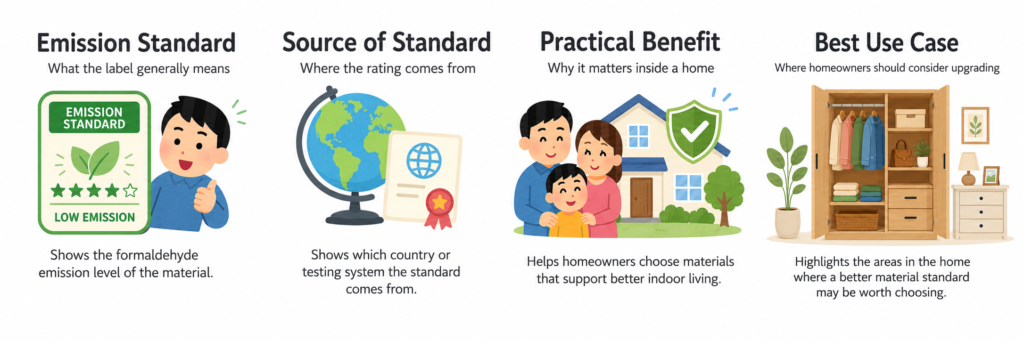
To keep this guide practical, we compare the three cabinet material ratings from a homeowner’s point of view.
We look at four main areas:
- Emission standard
This explains what the material label generally means and how much attention has been given to formaldehyde emission. - Source of standard
This explains where the rating or testing system comes from, such as European-based testing systems or Japanese standards. - Practical benefit
This explains why the material matters inside a real home, especially for indoor air quality and long-term comfort. - Best use case
This explains where homeowners should consider upgrading, such as bedrooms, wardrobes, children’s rooms, study rooms, and full-home cabinetry.
It is important to remember that formaldehyde standards are not always measured using the same method. Some standards use chamber testing, some use desiccator testing, and some are based on regional or national systems.
This means the material label should always be supported by a proper product test report.
What Are E0, Super E0, and F4 Stars?
1. What is E0?
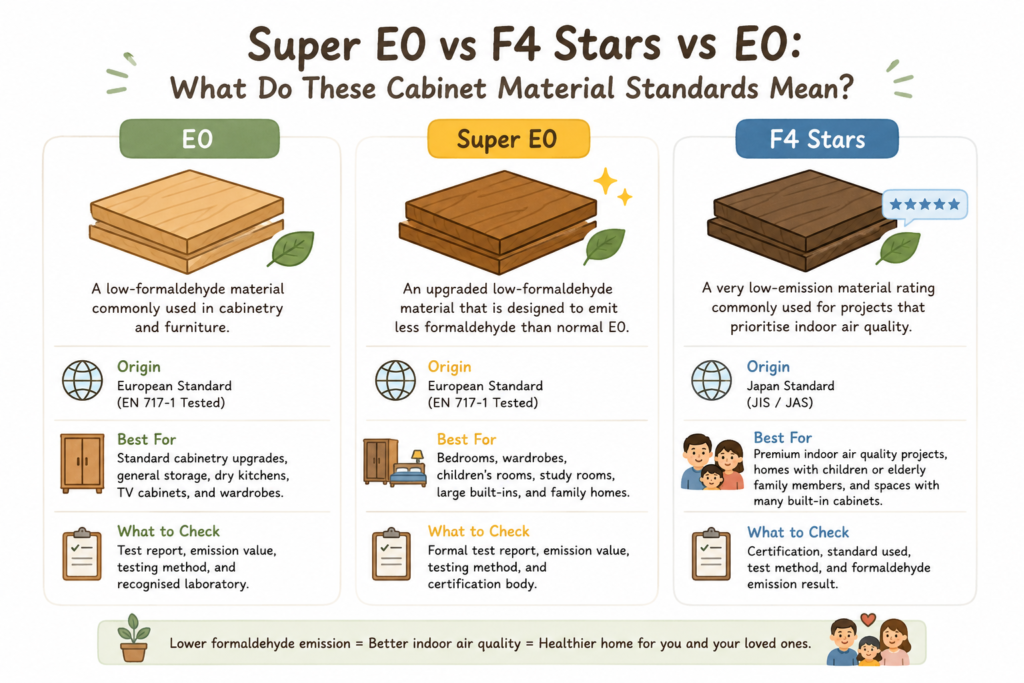
E0 refers to low-formaldehyde boards commonly used in cabinetry and furniture.
For homeowners, E0 is a better choice compared with conventional boards that do not have a clear low-emission rating. It is commonly used as a baseline option for safer and more responsible cabinet materials.
However, E0 standards may vary depending on the country, supplier, and testing method. That is why homeowners should always check the actual test report instead of relying only on the label.
2. What is Super E0?
Super E0 is an upgraded low-formaldehyde material that is generally designed to emit less formaldehyde than standard E0.
In simple terms:
E0 is low-emission. Super E0 is a lower-emission upgrade.
However, Super E0 is not always a universal government standard. In many cases, it is used as a supplier or manufacturer term to describe a better-performing board. This does not mean the claim is not useful. It simply means homeowners should ask for proof, such as the emission value, testing method, and certification body.
3. What is F4 Stars / F★★★★?
F4 Stars, also written as F★★★★, is a Japanese formaldehyde emission rating used for certain building and wood-based materials.
It is commonly recognised as a very low-emission material option.
For homeowners, F4 Stars materials are usually selected when indoor air quality is a higher priority. This is especially relevant for homes with children, elderly family members, sensitive occupants, or large amounts of built-in cabinetry.
The main difference between E0, Super E0, and F4 Stars is not just the name. The real difference is the formaldehyde emission level, testing method, and credibility of the documentation behind the material.
A reliable low-formaldehyde cabinet material should always be supported by proper certification or test results, not just a sticker or sales claim.
Why Low-Formaldehyde Cabinet Materials Are Important?
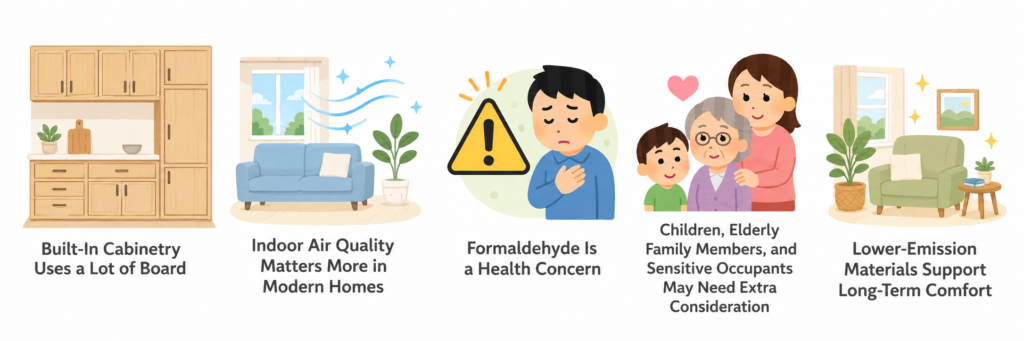
1. Built-In Cabinetry Uses a Lot of Board
Cabinetry is not one small item in the home.
A full kitchen, wardrobe, TV cabinet, shoe cabinet, vanity, and storage system can use many sheets of board. The more built-ins you install, the more important the material choice becomes. Even if each board emits only a small amount, the total surface area can add up across the whole home.
This is why low-formaldehyde cabinet materials are especially important for full-home renovation projects.
2. Indoor Air Quality Matters More in Modern Homes
Modern homes are often more enclosed.
Many homeowners rely on air-conditioning, sealed windows, and less natural ventilation. This can make indoor air quality more important, especially in bedrooms, wardrobes, study rooms, and enclosed storage areas.
In Malaysia, formaldehyde is recognised as one of the indoor air contaminants covered under the Department of Occupational Safety and Health Malaysia’s Industry Code of Practice on Indoor Air Quality 2010 (Department of Occupational Safety and Health Malaysia, 2010).
This is one reason homeowners should consider tested low-emission materials for built-in cabinetry.
3. Formaldehyde Is a Health Concern
Formaldehyde is widely recognized as a substance that should be controlled in indoor environments. It is used in many industrial applications, including resins for composite wood products. Depending on the exposure level and individual sensitivity, formaldehyde may also cause irritation.
This does not mean every cabinet is dangerous.
It simply means homeowners should choose tested, lower-emission materials whenever possible, especially for long-term living spaces.
4. Children, Elderly Family Members, and Sensitive Occupants May Need Extra Consideration
Some occupants may be more sensitive to indoor air quality.
This includes young children, elderly family members, pregnant mothers, and people who are sensitive to strong smells or indoor pollutants. For these homes, choosing Super E0 cabinet materials or F4 Stars cabinet materials may offer better peace of mind.
This is especially relevant for:
- Full-height built-in cabinets
- Bedrooms
- Wardrobes
- Children’s rooms
- Study rooms
- Nurseries
- Enclosed storage areas
5. Lower-Emission Materials Support Long-Term Comfort
A home should not only look good during handover.
It should feel comfortable after installation, after move-in, and years later. Choosing low-formaldehyde cabinet materials is part of building a home that feels more considered from the inside out.
It supports better long-term comfort, especially when cabinetry covers large areas of the home.
What Homeowners Should Ask Before Confirming Cabinet Materials?
Before choosing between E0, Super E0, and F4 Stars, ask these questions:
- What is the formaldehyde emission rating?
- Is it E0, Super E0, or F4 Stars?
- What is the actual emission value?
- Which test method was used?
- Which laboratory issued the test report?
- Is the test report recent?
- Does the material match the area where it will be installed?
- Is the cabinet properly laminated, edge-banded, and installed?
The label is important, but workmanship still matters. Even a good board should be properly sealed, laminated, fabricated, and installed to perform well in a real home.
Final Thoughts: E0, Super E0, and F4 Stars Are More Than Just Labels
E0, Super E0, and F4 Stars are not just technical labels. They help homeowners understand how much attention has been given to formaldehyde emission in the materials used for their cabinets.
- E0 is a good low-emission baseline.
- Super E0 is an upgraded option for homeowners who want lower emission than standard E0.
- F4 Stars is a premium low-emission choice, especially suitable for homes where indoor air quality is a serious priority.
At Nest Butler, we believe cabinetry should be beautiful, durable, and thoughtfully built for everyday living. That includes what you can see on the outside, and what you cannot see inside the material. Because a better home is not only about how it looks. It is also about how it feels to live in.
To learn more about materials standards and whether it suits your home, book an appointment with our project specialist for a personalized consultation.
Frequently Asked Questions About E0, Super E0, and F4 Stars
Is Super E0 better than E0?
Yes, Super E0 is generally positioned as a lower-emission upgrade compared with E0. However, homeowners should always ask for the test report because “Super E0” can be used differently by different suppliers.
Is F4 Stars better than E0?
F4 Stars is commonly recognised as a very strict low-formaldehyde rating, especially in Japanese building material standards. For homeowners who prioritise indoor air quality, F4 Stars is usually considered a premium choice.
Does low-formaldehyde mean formaldehyde-free?
Not necessarily. Low-formaldehyde means the material is designed to emit less formaldehyde, but it does not always mean zero emission. Always check the actual test result.
Why does formaldehyde matter in cabinetry?
Cabinetry uses large amounts of board across kitchens, wardrobes, bedrooms, storage, and feature walls. Because composite wood products can emit formaldehyde, choosing lower-emission materials can help improve indoor comfort and peace of mind.
Should I upgrade the whole house to Super E0 or F4 Stars?
It depends on your budget and priorities. A practical approach is to prioritise bedrooms, wardrobes, children’s rooms, study rooms, and enclosed spaces first. For full-home cabinetry, upgrading more areas may be worth considering.
Is the material label enough?
No. The label is only part of the decision. A reliable material should be supported by a proper test report, and good workmanship is still important for long-term performance.
References:
Department of Occupational Safety and Health Malaysia. (2010). Industry code of practice on indoor air quality 2010. Ministry of Human Resources Malaysia. https://www.dosh.gov.my